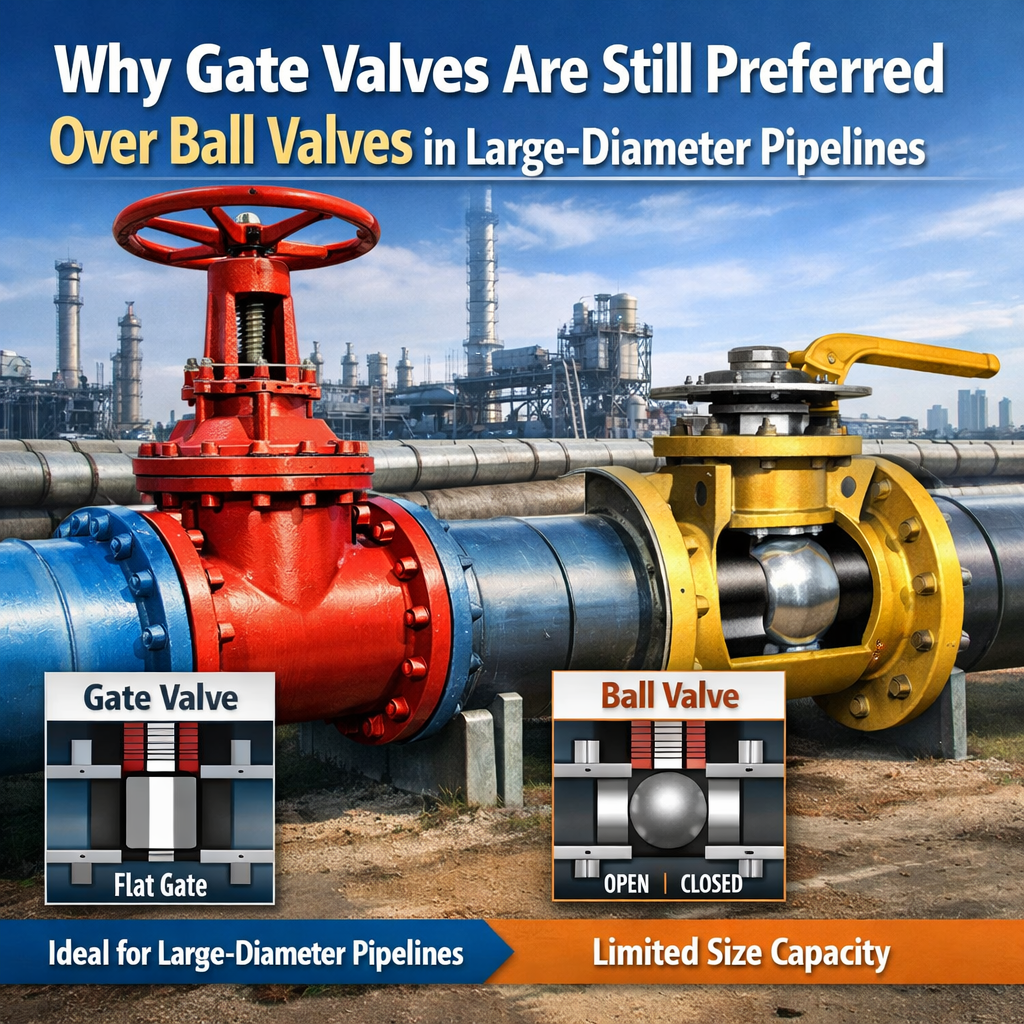
In large-diameter pipeline systems, valve selection plays a critical role in ensuring operational efficiency, long service life, and cost control.
Industries such as water transmission, oil & gas, power generation, desalination, and industrial utilities rely on robust isolation valves that can perform reliably under high flow and pressure conditions. While ball valves have gained popularity in smaller pipeline sizes, gate valves continue to be the preferred choice for large-diameter pipelines. This preference is driven by cost advantages, design suitability, operational ease, and long-term reliability.
Cost Effectiveness in Large Sizes :
One of the primary reasons gate valves are favoured in large-diameter pipelines is cost. As valve size increases, the manufacturing cost of ball valves rises significantly due to the massive forged or cast ball, precision-machined seats, and heavy body construction. These factors make large ball valves expensive and often impractical for extensive pipeline networks.
Gate valves, by contrast, have a simpler internal design that scales more economically. This cost advantage is why many valve manufacturers produce gate valves as standard offerings in larger sizes and why Gate Valve Suppliers are able to maintain competitive pricing. Most valve suppliers and valve stockist recommend gate valves for large pipeline projects where budget optimization is essential.
Full Bore Design and Unrestricted Flow :
Large-diameter pipelines are designed to carry high volumes of fluid with minimal pressure loss. Gate valves provide a true full-bore opening, meaning the flow path is completely unobstructed when the valve is fully open. This results in lower pressure drop, reduced turbulence, and improved energy efficiency.
Although ball valves can also offer full-bore designs, achieving this in large sizes requires heavier construction, increasing weight and cost. As a result, many Ball Valve Suppliers limit full-bore designs to smaller or mid-range sizes. Gate valves remain the practical solution for applications where uninterrupted flow is critical.
Lower Operating Torque and Easier Actuation :
Operating torque becomes a major concern as valve size increases. Large ball valves require substantial torque to rotate the ball, often necessitating heavy gearboxes or expensive actuators. This increases both capital and maintenance costs.
Gate valves operate using a linear motion mechanism, where the gate moves vertically to open or close the flow path. This design requires comparatively lower operating torque, making gate valves easier to operate manually or with standard actuators. Because of this advantage, valve suppliers frequently recommend gate valves for large-diameter manual, electric, or motor-operated applications.
Proven Reliability in Long-Term and Buried Service :
Many large-diameter pipelines are installed underground or in locations where frequent maintenance is difficult. These systems are expected to operate reliably for decades. Gate valves have a long history of proven performance in such conditions, particularly in water supply, wastewater treatment, and transmission pipelines.
Due to this reliability, a trusted Valve Stockist in UAE typically maintains extensive inventories of large-size gate valves to meet the region’s infrastructure and industrial demands. Gate valves are widely specified in municipal and utility projects because of their durability and predictable performance.
Availability as Stock Valves :
Another major advantage of gate valves is their availability. Most valve manufacturers produce gate valves in standardized large sizes, allowing valve stockists to maintain ready inventory. These stock valves reduce project lead times and ensure faster delivery for urgent requirements or shutdown replacements.
In comparison, large-diameter ball valves are often manufactured on order, resulting in longer delivery schedules. This makes gate valves the preferred option when project timelines are tight.
Comparison with Butterfly Valves :
Butterfly valves are often considered a lightweight and economical alternative for large pipelines. While they are suitable for flow regulation and certain low-pressure applications, butterfly valves introduce partial flow obstruction and may not provide tight shut-off in critical isolation duties.
Many Butterfly Valve Suppliers position their products for flow control rather than full isolation. Gate valves, on the other hand, provide complete shut-off with zero obstruction, making them the safer and more reliable choice in high-pressure or critical pipeline systems.
Industry Standards and Specifications :
Across industries, international standards and engineering specifications continue to favor gate valves for large-diameter pipelines. Their long service history, predictable performance, and ease of maintenance make them a trusted choice for engineers and project consultants. As a result, Gate Valve Suppliers, valve manufacturers, and valve suppliers continue to play a vital role in major infrastructure developments.
Conclusion :
Despite the availability of modern valve technologies, gate valves remain the preferred solution for large-diameter pipelines. Their cost efficiency, full-bore design, low operating torque, long service life, and widespread availability as stock valves make them unmatched for large-scale applications.
While Ball Valve Suppliers and Butterfly Valve Suppliers offer effective solutions for specific use cases, gate valves continue to dominate large-diameter pipeline systems. Supported by reliable valve manufacturers, experienced valve suppliers, and established valve stockists—especially a dependable Valve Stockist in UAE—gate valves remain the backbone of critical pipeline infrastructure.